

Unlock the White House Watch newsletter for free
Your guide to what Trump’s second term means for Washington, business and the world
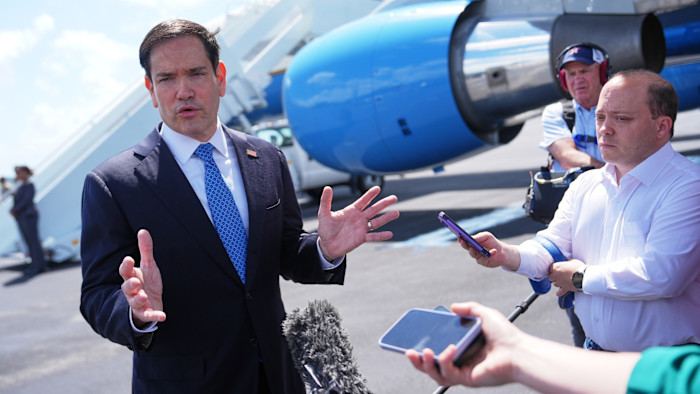
Marco Rubio said there were “some good signs” that Washington could reach a deal with Iran as regional mediators intensified their efforts to build on a fragile ceasefire and prevent a return to full-scale war.
The US secretary of state said he expected Pakistani mediators — who have been leading weeks of diplomatic efforts to end the conflict — to travel to Iran as Tehran reviews the latest proposal from Donald Trump’s administration.
“I think we’ve made some progress, but obviously we are dealing with a system that is a little fractured, the Iranian system,” Rubio said. “But that said, I believe the Pakistanis will be travelling to Tehran today, so hopefully that will advance this further. There’s some good signs, but I don’t want to be overly optimistic as well.”
The US and Iran have for weeks been haggling over proposals and counterproposals to reopen the Strait of Hormuz, tackle Washington’s concerns over Tehran’s nuclear programme and the Islamic republic’s demand for sanctions relief.
Iran’s semi-official news agency ISNA on Thursday said the latest US draft had “narrowed the gaps to some extent”. But it added that closing them required “overcoming the temptation of war on Washington’s part”.
Mohsin Naqvi, Pakistan’s interior minister, held talks with Iran’s foreign minister Abbas Araghchi on Thursday. He is a close confidant of Pakistan’s powerful military chief Field Marshal Asim Munir, who has been leading Islamabad’s mediation efforts.
The latest diplomatic push comes amid concerns that if the parties fail to reach an agreement soon, the US and Israel could resume strikes on Iran. That would reignite a conflict that spread across the Middle East as Tehran fired barrages of missiles and drones at Washington’s Gulf allies.
Iran has slowed the flow of traffic through the strait to a trickle since the US and Israel launched their attack on February 28, triggering the worst global energy crisis in decades. The US Navy is also imposing a blockade to prevent ships leaving or entering Iranian ports.
Trump on Monday said he was holding off on renewing attacks on Iran — that he said would have been launched the following day — while adding that “serious negotiations” with Tehran were taking place.
He said Saudi Arabia, Qatar and the United Arab Emirates had asked him to suspend the military assault. Riyadh and Doha are supporting Pakistan’s mediation efforts.
Trump on Wednesday repeated his warning that the US could hit Iran “even harder” if Tehran does not agree to a deal.
Iran has been pressing for the lifting of US sanctions, an end to the war “on all fronts” — a reference to Israeli strikes in Lebanon — and for Tehran’s “management” of the strait. It has demanded an end to the US blockade on its ports and said it was seeking a 30-day suspension of oil sanctions, during which its frozen assets held overseas could be released.
A previous Pakistani-backed proposal called for a 30-day period for confidence-building steps, after which negotiations on its nuclear programme would begin.
The US has been demanding that Iran agree to a 20-year moratorium on its nuclear enrichment programme, that it transfer its stockpile of uranium enriched close to weapons-grade levels out of the country and dismantle its three main nuclear facilities at Natanz, Fordow and Isfahan.
Iran insists it has a right to enrich uranium as a signatory to the international treaty on the non-proliferation of nuclear weapons. It has publicly said it would not allow its stockpile of enriched uranium to leave the country.
Trump on Thursday said the US would eventually take control of Iran’s 440kg of highly enriched uranium. “We will get it. We don’t need it, we don’t want it. We’ll probably destroy it after we get it, but we’re not going to let them have it,” he said.


