

An inspiring story of heritage, determination, representation and the growing influence of Nigerians and people of Nigerian descent in public leadership across the United States.
There are moments when the achievements of people living thousands of miles away remind an entire nation of the extraordinary potential of its people. Such moments transcend geographical boundaries, political affiliations and national identities. They remind us that the values, determination, intellectual capacity and ambition associated with a people can find expression in different societies and under different circumstances.
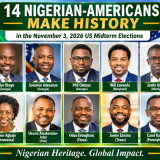
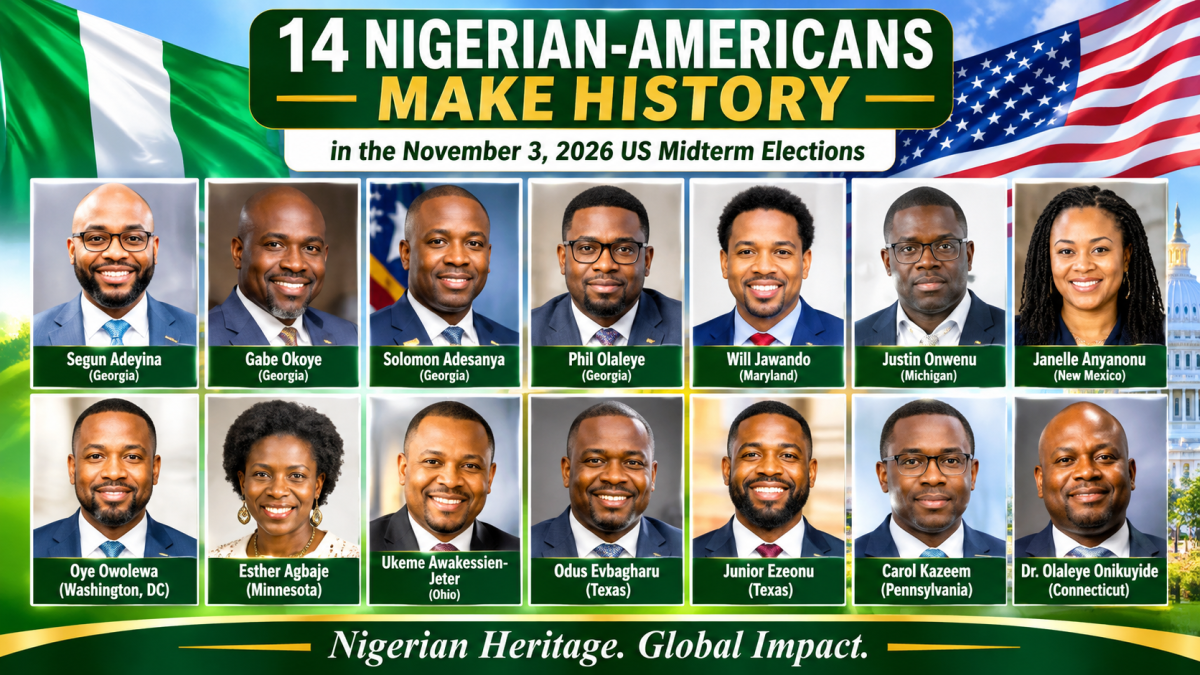
For Nigeria, one such moment came with the November 3, 2026, United States midterm elections, when 14 Nigerian-Americans emerged victorious in various elective contests across the country. Their successes, spanning state legislatures and local government institutions in nine states and Washington, DC, represent more than a collection of electoral victories. They offer a powerful opportunity to celebrate the achievements of Nigerians and people of Nigerian descent who are contributing to public leadership and governance beyond their ancestral homeland.
The victories attracted the attention of the Nigerians in Diaspora Commission (NiDCOM), whose Chairman and Chief Executive Officer, Hon. Abike Dabiri-Erewa, congratulated the 14 successful candidates on November 4, describing their achievements as evidence of the growing role of the Nigerian diaspora in public leadership.
For a country whose citizens and descendants have established themselves in virtually every corner of the world, this development is particularly significant. It is a reminder that the Nigerian story is not written exclusively within Nigeria’s geographical boundaries. It is also being written in the classrooms, laboratories, hospitals, businesses, professional institutions and political establishments of other nations.
And in the United States, 14 individuals of Nigerian heritage have just provided another remarkable chapter in that story.
Fourteen Victories, One Remarkable Nigerian Connection
The successful candidates emerged from different backgrounds, professional experiences and political constituencies. Some secured positions in state legislatures, others retained existing offices, while some achieved victories in local government contests. Their accomplishments demonstrate the different ways in which people of Nigerian heritage are becoming involved in the institutions that influence American public life.
Among the most prominent victories was that of Will Jawando, who won the election for Montgomery County Executive in Maryland. His victory placed him in a significant county leadership position, with responsibilities that extend across public administration, community development, local services and policy implementation.
Oye Owolewa secured an at-large seat on the Council of the District of Columbia, continuing his involvement in the legislative affairs of the American capital.
In Texas, Junior Ezeonu won the contest for District 101 in the Texas House of Representatives, adding another Nigerian-American voice to the state’s legislative institution.
Carol Kazeem retained her seat in the Pennsylvania House of Representatives, representing District 159, demonstrating the continued confidence placed in her by her constituents.
Georgia also recorded several notable victories. Segun Adeyina won the contest for State House District 110, while Gabe Okoye secured District 102. Phil Olaleye and Solomon Adesanya also emerged victorious in their respective Georgia State House contests.
In Minnesota, Esther Agbaje secured re-election to the State House of Representatives, maintaining her place in the state’s legislative process.
These are not merely names appearing on an electoral list. Each represents an individual who has entered, or continued in, a position of public responsibility through the democratic process. Their victories carry expectations, responsibilities and the opportunity to make a meaningful difference in the communities they represent.
The Other Nigerian-American Winners Whose Achievements Deserve Recognition
The celebrations would be incomplete without recognising the other successful candidates whose victories contributed to the remarkable total of 14.
In Connecticut, Olaleye Onikuyide secured election to the State House of Representatives for District 19. At a time when younger generations are increasingly seeking opportunities to participate in public affairs, his achievement represents an encouraging example of political engagement.
Ohio also recorded a Nigerian-American victory through Ukeme Awakessien-Jeter, who won the State House contest for District 7. Her political experience and previous involvement in local government provide an interesting example of how community-level public service can become a pathway to wider legislative responsibilities.
In Texas, Odus Evbagharu won the election for State House District 135, adding another Nigerian-American representative to the state’s political landscape.
Michigan produced another victory through Justin Onwenu, who won election to the State Senate for District 1.
New Mexico also joined the list of states recording a Nigerian-American electoral success, with Janelle Anyanonu winning the contest for State House District 19.
Together with the other winners, these candidates bring the total to 14.
Their successes are particularly noteworthy because they extend across different regions of the United States. From Maryland and Pennsylvania to Georgia, Texas, Minnesota, Connecticut, Ohio, Michigan and New Mexico, as well as Washington, DC, the Nigerian connection was visible across a wide geographical and political landscape.
The Significance of Their Victories Goes Beyond Political Titles
An electoral victory is often celebrated through the announcement of results, congratulatory messages, photographs and public appearances. However, the significance of these 14 victories deserves a deeper examination.
Winning an election in the United States requires candidates to operate within an established democratic environment in which public opinion, community relationships, political organisation, fundraising, policy communication and voter participation all play important roles.
Candidates must introduce themselves to communities, explain their priorities, engage with constituents, respond to public concerns and persuade voters that they can be trusted with public responsibilities.
They must also navigate political parties, electoral rules, campaign structures and the complex interests that influence local and state politics.
For Nigerians watching from home, these victories provide an opportunity to appreciate the importance of participation in public affairs. They demonstrate that people of Nigerian heritage are not limited to professional achievements in medicine, engineering, technology, education, finance and business. They are also participating in the political institutions that determine how communities are governed.
This is an important dimension of diaspora achievement.
A society’s development is influenced not only by the number of successful professionals it produces but also by the extent to which its people participate in the institutions responsible for making decisions, shaping policies and allocating public resources.
The election of these Nigerian-Americans therefore deserves recognition as an important contribution to the broader story of Nigerian participation in international public life.
Nigeria’s Human Capital Is One of Its Greatest International Assets
Nigeria is a country of enormous human potential. Its population has produced individuals who have distinguished themselves across different continents and professional fields. Nigerian doctors, academics, engineers, entrepreneurs, researchers, artists, lawyers and technology specialists have established successful careers in countries with very different economic and institutional environments.
The achievements of the Nigerian diaspora have frequently attracted attention because they demonstrate the ability of Nigerians to adapt, compete and contribute in demanding professional environments.
The 2026 American election victories add another dimension to this international presence.
They suggest that Nigerian heritage is increasingly represented not only in professional and commercial establishments but also in institutions of political decision-making.
It is worth recognising the importance of this development without assuming that every Nigerian-American has the same background or experience. Some may have been born in Nigeria and subsequently relocated to the United States. Others may have been born and raised in America to Nigerian parents, while some belong to later generations of Nigerian-American families.
What connects them is their Nigerian ancestry and the recognition that their achievements contribute to the wider Nigerian diaspora story.
For Nigeria, the significance is not that these individuals have abandoned one national identity for another. Rather, their achievements illustrate how people can develop meaningful relationships with more than one cultural heritage while making valuable contributions to the societies in which they live.
Their success should be a source of encouragement to Nigerian families raising children abroad, as well as young Nigerians who aspire to careers that extend beyond conventional professional boundaries.
A Lesson in Political Participation for Young Nigerians
Perhaps one of the most important lessons from these victories is the value of participation.
In many countries, political leadership is not reserved exclusively for individuals from particular family backgrounds or established political dynasties. Although access to political opportunities can be influenced by financial resources, social networks, institutional structures and other factors, elections provide a recognised avenue through which individuals can seek public office and earn the confidence of voters.
The achievements of these Nigerian-Americans offer an opportunity for young Nigerians to appreciate that public leadership is also a profession requiring preparation, commitment, public engagement and a willingness to accept responsibility.
Nigeria’s younger generation should see politics not merely as a contest for power, but as an opportunity to contribute to education, healthcare, economic development, infrastructure, environmental protection, social welfare and the effective administration of public institutions.
The achievements of these 14 individuals do not suggest that the American political system is without challenges, nor should their victories be used to romanticise governance in another country. Rather, they offer an encouraging example of how people of Nigerian heritage can participate in the political process of their communities and earn the opportunity to serve.
There is something particularly inspiring about seeing people whose families have Nigerian roots occupy positions from which they can influence decisions affecting the everyday lives of thousands of residents.
The Role of NiDCOM and the Importance of Recognising Diaspora Achievements
The congratulatory message issued by the Nigerians in Diaspora Commission was an important gesture.
By publicly recognising the 14 winners, NiDCOM drew attention to an aspect of diaspora achievement that deserves more consistent national appreciation.
The commission’s Chairman and Chief Executive Officer, Abike Dabiri-Erewa, congratulated the successful candidates and wished them successful and impactful tenures.
Such recognition is important because the relationship between Nigeria and its diaspora should extend beyond remittances, investment discussions and occasional diplomatic engagements.
The diaspora is also a source of professional experience, international relationships, knowledge, cultural influence and leadership.
Nigerians living abroad can contribute to the development of their ancestral homeland in different ways, whether through direct investment, knowledge exchange, educational partnerships, mentorship, philanthropy or participation in international institutions.
The success of Nigerian-Americans in elective office presents another opportunity to strengthen these relationships.
It would be worthwhile for Nigerian institutions, universities, professional associations and diaspora organisations to establish stronger platforms through which accomplished Nigerians abroad can share their experiences with younger generations at home.
The objective should not be to turn successful diaspora politicians into symbols of political superiority, but to learn from their experiences, understand their journeys and identify practical lessons that can benefit Nigerian society.
Celebrating Them While Wishing Them Greater Responsibilities
As Nigerians celebrate these 14 electoral victories, it is equally important to remember that election to public office is the beginning of another demanding journey.
The real test of public leadership begins after the celebrations. Constituents will expect effective representation, responsible decision-making, accountability, transparency and measurable attention to the issues affecting their communities.
Each of the successful candidates now has an opportunity to translate electoral confidence into meaningful public service.
Will Jawando has an important responsibility in Montgomery County. Oye Owolewa will continue to face the demands of representing residents of Washington, DC. Junior Ezeonu, Carol Kazeem, Segun Adeyina, Gabe Okoye, Phil Olaleye, Solomon Adesanya, Esther Agbaje, Olaleye Onikuyide, Ukeme Awakessien-Jeter, Odus Evbagharu, Justin Onwenu and Janelle Anyanonu all have constituencies whose expectations will accompany their new mandates.
Their different offices come with different responsibilities, but the underlying obligation is the same: to serve the public with dedication and integrity.
For Nigeria, their future performance will also influence how their achievements are remembered. The greatest celebration would be to see them justify the confidence placed in them by their voters and leave positive contributions in the institutions they now serve.
A Nigerian Celebration That Crosses Continents
There is a reason why these victories should resonate beyond the Nigerian-American community.
They remind us that the Nigerian story is much larger than the daily challenges confronting the country. Nigeria has its difficulties, and those difficulties deserve honest attention. But a nation must also learn to recognise its achievements, celebrate its outstanding citizens and appreciate the positive contributions of its people wherever they may be found.
A Nigerian heritage can be carried into a university lecture hall in London, a hospital in Canada, a technology company in California, a research institution in Germany or a legislative chamber in the United States.
In each of these places, individuals of Nigerian origin have opportunities to contribute to the societies around them while maintaining meaningful connections with their ancestry.
The November 3, 2026, American midterm elections have provided another example of this expanding Nigerian presence.
Fourteen individuals of Nigerian descent have secured electoral victories across different American jurisdictions. Their achievements deserve recognition, not simply because of their ancestry, but because they have participated in the democratic process and earned opportunities to serve their communities.
To the 14 Nigerian-American winners, congratulations.
May your victories become the foundation for meaningful public service, responsible leadership and lasting contributions to the communities that have entrusted you with their votes.
May your achievements inspire young Nigerians, both at home and abroad, to understand that their ambitions need not be limited by geography, background or inherited expectations.
And may Nigeria continue to recognise, celebrate and learn from the accomplishments of its people wherever the world provides them with an opportunity to excel.
From Nigeria to America, the story continues. Fourteen victories, countless sources of inspiration, and another reason for Nigerians everywhere to celebrate the extraordinary possibilities of their heritage.